Phishing URL detection
Classifies submitted URLs as safe, suspicious, or malicious using lexical, host, page-content, and threat-intelligence signals.
CyberShield AI is a phishing scanner built by Cyberium Technologies in Nepalgunj, Nepal. It checks suspicious links, emails, and files for phishing and malware, then explains the risk in plain language for individuals, small businesses, and schools across Nepal.
01Product in development
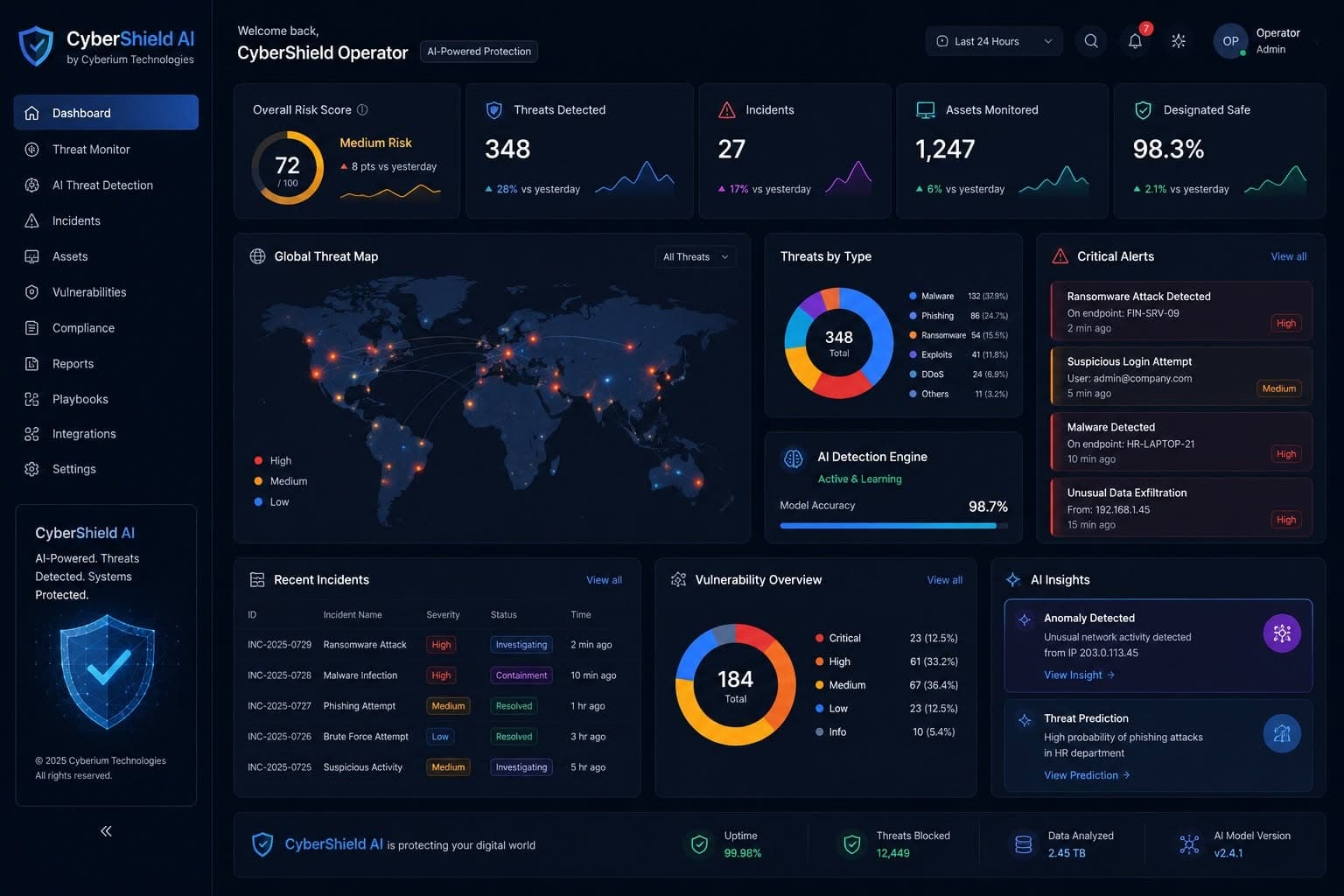
Cybershield-AI brings threat detection, vulnerability assessment, continuous monitoring, and automated incident response into one accessible platform. It is designed to analyze URLs, emails, files, and network activity, then turn the results into a clear risk score and practical remediation steps through an AI security assistant.
Surface risk before it becomes an incident.
Find weaknesses such as outdated software, missing security headers, and open ports.
Watch network flows and logs for unusual activity, intrusion, and data exfiltration signals.
Turn high-risk alerts into trackable incidents that teams can acknowledge, assign, and resolve.
Why it exists
Many individuals, small businesses, and schools rely on separate URL checkers, antivirus tools, email scanners, and network monitors. Each produces different results, formats, and recommendations, leaving non-technical users to assemble their own picture of risk.
CyberShield-AI is designed to close that gap with one accessible platform. Instead of depending only on known-threat databases, it combines machine-learning classification with threat-intelligence lookups to help surface new and changing attacks sooner.
The goal is practical protection without the cost or complexity of an enterprise SIEM: understandable findings, visible confidence and evidence, and a clear path from detection to corrective action.
Detection and assessment
Classifies submitted URLs as safe, suspicious, or malicious using lexical, host, page-content, and threat-intelligence signals.
Checks email content and headers for spoofed senders, malicious links, urgency language, and other phishing indicators.
Analyzes uploaded files using static features such as headers, entropy, and imported functions, with behavioral signals where feasible.
Identifies anomalous traffic patterns that may indicate intrusion, command-and-control activity, or data exfiltration.
Surfaces failed logins, privilege escalation attempts, and unusual access patterns from system and application logs.
Reports weaknesses in web assets and configurations, ranked by severity so users know what to fix first.
A complete response layer
Explains scan verdicts in plain language, answers security questions, and recommends remediation steps tailored to each finding.
Combines signals from detection modules and threat-intelligence lookups into one clear security posture.
Notifies relevant users and administrators about high-risk findings through in-app, email, and planned optional SMS channels.
Converts qualifying alerts into incidents with assignment, status, acknowledgement, and resolution workflows.
Turns scan, alert, and incident history into exportable reports, trends, top threat categories, and resolution-time insights.
Supports role-based access and a planned cybersecurity awareness quiz to make safer decisions easier for every user.
How it works
A user submits a URL, email, file, QR code, network data, or log for analysis.
The relevant machine-learning model and threat-intelligence sources inspect the input.
Signals are combined into a risk classification, confidence score, and severity-aware result.
The dashboard and AI assistant translate technical evidence into understandable guidance.
Alerts become actionable incidents that can be assigned, tracked, notified, and resolved.
Built for real teams
The planned role-based dashboard gives each person the context they need while keeping security operations in one shared system.
Submit content for scanning, view results, follow recommendations, and ask the AI assistant questions.
Review findings, investigate alerts, manage incidents, and generate reports for the organization.
Manage users and roles, configure detection policies and thresholds, and oversee audit logs and system health.
Planned system design
The prototype is planned as a service-oriented system so detection models can be trained, replaced, or scaled independently from the dashboard and API.
| Layer | Planned technology | Purpose |
|---|---|---|
| Frontend | React.js, Vite, Tailwind CSS, Zustand, and Recharts | Responsive dashboard, state management, and visual analytics. |
| Backend and API | Laravel, PHP, and JWT authentication | REST APIs, request routing, business logic, and access control. |
| AI and ML | Python, scikit-learn, TensorFlow/PyTorch, spaCy/Transformers | Phishing, malware, email, and network anomaly models. |
| Data and intelligence | MySQL, log storage, VirusTotal, AbuseIPDB, and PhishTank | Persistent records and reputation signals that supplement model results. |
| Infrastructure | Docker, Nginx, cloud VM, Git, and GitHub Actions | Containerized prototype deployment, reverse proxy, version control, and CI. |
Prototype quality goals
Target verdicts for URL and email scans within 3 seconds under typical load.
Keep backend services stateless and horizontally scalable as scan volume grows.
Use short-lived JWT access tokens, refresh tokens, bcrypt passwords, and HTTPS/TLS.
Process URLs, files, and email content transiently where possible and minimize retention.
Make results understandable to people without prior cybersecurity training.
Evaluate models with precision, recall, F1-score, and ROC-AUC plus integration and user testing.
Expected prototype outcome
The planned prototype will demonstrate a web dashboard where registered users can submit URLs, emails, files, and QR codes, then view consolidated risk verdicts and alerts.
It will bring together evaluated detection models, an AI security assistant, automated notifications, incident workflows, role-based experiences, and reporting in one system.
CyberShield-AI is currently under development. Its purpose is to reduce the technical and financial barriers that prevent individuals, schools, and small businesses from acting on cybersecurity risks early.
Stay close to the launch
CyberShield AI is built by our team at Cyberium Technologies, an IT company in Nepalgunj. Until launch, explore our cybersecurity training in Nepal and AI solutions in Nepal, or contact our team to discuss your security needs.
Tell us what you are building. We reply within one business day.